
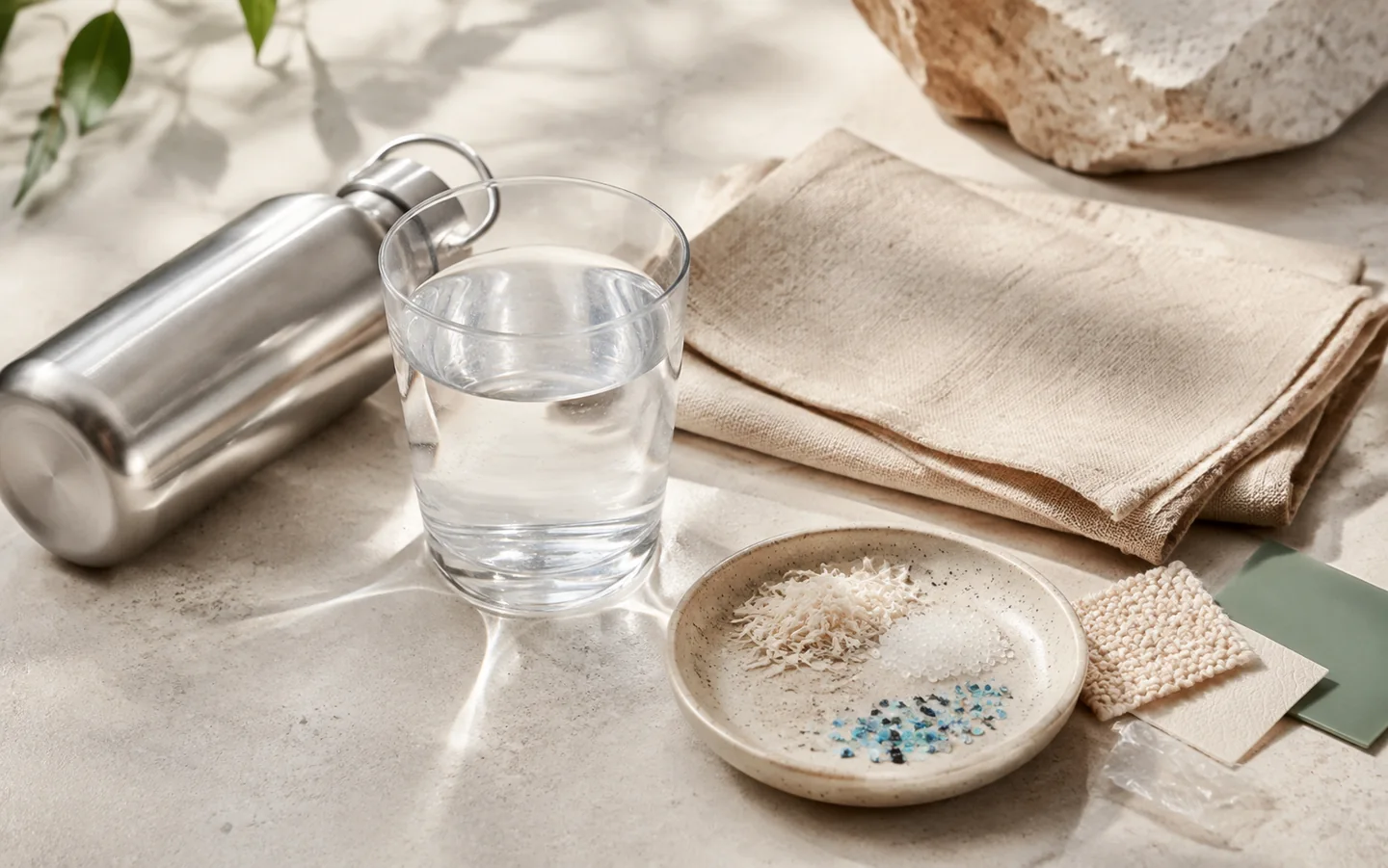
Microplastics are plastic particles smaller than five millimetres. They have been detected in water, food and air, but exact exposure and health effects are still difficult to establish. The sensible response is measured: reduce sources where practical, without pretending that one filter, product or “detox” can resolve every uncertainty.
What exactly are microplastics?
The European definition generally uses an upper limit of five millimetres. Within that group, particles vary widely in size, shape and composition. A fibre released from synthetic textiles is not the same as a pellet from an industrial process. Additives and ageing differ too. Detecting “microplastics” therefore does not by itself show how much a person absorbs or what that means biologically.
A common distinction is made between primary and secondary microplastics. Primary particles are already small when produced for a particular use. Secondary particles result from wear and breakdown, for example from tyres, paint, packaging or textiles. The European REACH restriction adopted in 2023 focuses on intentionally added synthetic polymer microparticles and applies different transition periods to different product groups.
Through which routes can we encounter them?
The Dutch National Institute for Public Health and the Environment describes three broad routes: food, drinking water and inhalation. Particles have been measured in various foods, indoor and outdoor air, and water. That does not mean that every route contributes equally. Measurement methods are not yet fully comparable, and contamination of samples is especially difficult to exclude for very small particles.
The World Health Organization reviewed evidence on drinking water in 2019 and published a broader assessment of exposure through food and air in 2022. Both reports identify substantial knowledge gaps. There is good reason for careful research and for reducing plastic pollution, but not for firm personal health conclusions based on a single measurement or headline.

What do we know, and what remains uncertain?
| Reasonably clear | Still uncertain |
|---|---|
| Microplastics occur widely in the environment. | The total dose people take in across all routes. |
| Particles have been measured in food, water and air. | How results from different studies can be compared precisely. |
| Plastic emissions can be reduced. | What long-term exposure to different particles means for people. |
| EU rules are phasing in limits on intentionally added microplastics. | Which individual measure changes personal exposure the most. |
This separation matters. Detecting a particle is not the same as proving a cause of disease. Conversely, uncertainty does not mean pollution deserves no attention. Careful communication holds both truths at the same time.
Does bottled water have a clear advantage over tap water?
Current evidence does not support such a general conclusion. Studies differ in sampling, particle-size thresholds and analytical methods. Both tap and bottled water have been studied, but results cannot be translated directly to every local situation. Choose water using reliable local water information, taste, cost and waste considerations, not an absolute microplastic promise.
Which choices are practical without creating false certainty?
Start with the aim that is clear: reducing unnecessary plastic emissions. That is different from promising to “cleanse” the body. Small, workable choices include:
- use reusable products for a long time rather than rapidly replacing them with a new “sustainable” option;
- follow the use and temperature instructions for food packaging and storage containers;
- prevent litter and sort waste according to local guidance;
- wash synthetic textiles only when needed, with a full load and a gentle programme;
- consider the full formula and purpose of a cosmetic, not one isolated marketing term.
A filter may be useful in a specific setting, but the phrase “microplastic filter” is not a universal quality guarantee. Ask which particle sizes were tested, under which conditions and how often components need replacing. Without that information, a technical-sounding claim is hard to assess.
Why is “detoxing” not a careful answer?
The reviewed sources do not establish that a supplement, juice cleanse or cosmetic product removes microplastics from the human body. Such promises exploit uncertainty rather than resolving it. Anyone concerned about a specific exposure at work or at home is better served by a doctor, occupational hygienist or local public-health service.
Good Nature Vibe chooses transparency here: what has been measured, what is not yet known, and which choices mainly reduce emissions. Read how we approach quality and verifiable information, or explore more topics in the GNV knowledge journal.
Frequently asked questions about microplastics
Are microplastics the same as nanoplastics?
No. Nanoplastics are smaller and therefore even harder to measure reliably. Definitions and measurement thresholds also differ between publications.
Can microplastics be avoided completely?
That is not realistic because particles occur widely in the environment. You can contribute to lower emissions and use products according to their instructions.
Should I buy a water filter now?
Not out of fear alone. Check local water information and ask for independent test data, particle-size ranges, capacity and maintenance requirements.
Does “microplastic-free” tell me everything about a cosmetic?
No. It says nothing about the rest of the formula, suitability for your skin or the support for other claims. Read the full label and instructions.
Which sources were used?
- RIVM, information on plastics and health effects, accessed 5 September 2026.
- World Health Organization, Microplastics in drinking-water, 2019.
- World Health Organization, Dietary and inhalation exposure to nano- and microplastic particles, 2022.
- European Commission and ECHA, guidance on Regulation (EU) 2023/2055 concerning intentionally added microplastics.
Editorially reviewed for source accuracy and claim safety on 5 September 2026. This article provides general information, not medical advice.


