
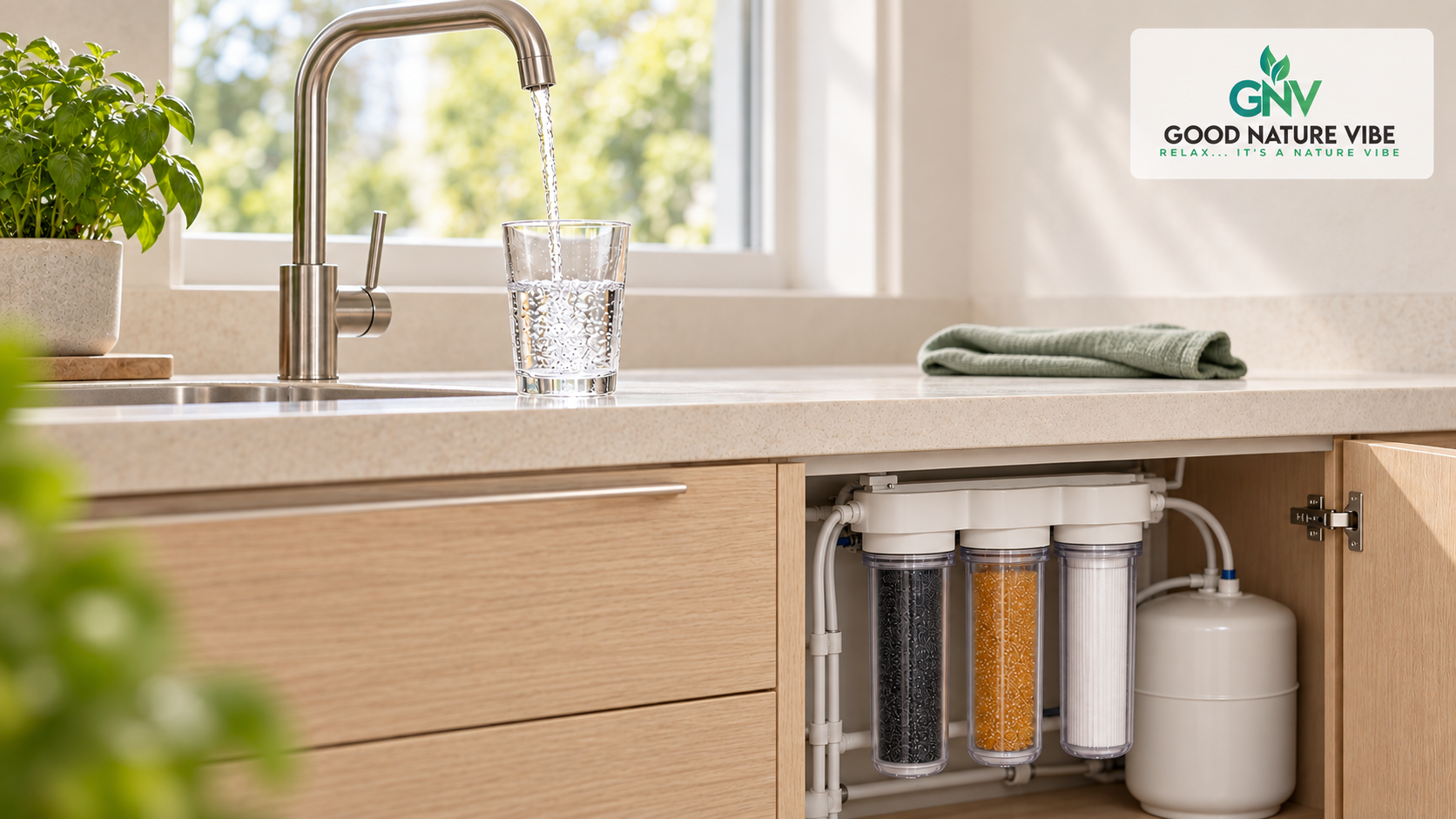
A PFAS water filter can reduce certain PFAS in drinking water, but the result depends on the product and how it is used. A familiar filter technology, a high price or a large percentage on the packaging does not explain everything you need to know.
The useful questions are more specific. Which substances were tested? What concentration remained? Was the exact model assessed independently? And what maintenance is needed for the performance claim to remain relevant?
Start with information about your water, then consider the evidence for a particular filter. A system intended to improve taste is not automatically a system tested for PFAS. This guide explains the main approaches and gives you practical questions to ask before comparing products.
What is a PFAS water filter?
The term usually describes a water filter marketed with a claim about reducing PFAS. It does not mean every substance in this large chemical family is treated equally well.
PFAS stands for per- and polyfluoroalkyl substances. These manufactured chemicals have different properties, and many persist for a long time. The nickname ‘forever chemicals’ describes that persistence; it does not make them one identical substance.
PFOA and PFOS are two well-known examples. Evidence for those compounds should not be presented as evidence for every PFAS. Read the actual list of substances covered by a claim rather than relying on a general statement about ‘clean water’.
Products also come in different forms, including jugs, systems serving one tap and installations treating incoming household water. The format tells you where treatment happens. The model’s documentation tells you what has been demonstrated.For the wider background, read our explanation of forever chemicals and the different substances within the PFAS family.
Can filters reduce PFAS in water?
Yes. Activated carbon, suitable ion-exchange resins and reverse osmosis are among the approaches used. They hold substances in a material or separate them from water. That is different from destroying the chemicals.
An EPA research summary published in 2020 provides a useful example. Two tested reverse-osmosis systems produced results below the laboratory detection limit of 3 parts per trillion during a one-week study. Another tested system had detectable concentrations during intermittent operation.
Those findings apply to the systems and conditions examined. They are not a promise for every filter or its entire lifespan. ‘Below the detection limit’ also means the method could not quantify the concentration below that point; it does not prove absolute absence.
Which filtration methods are relevant?
Activated carbon
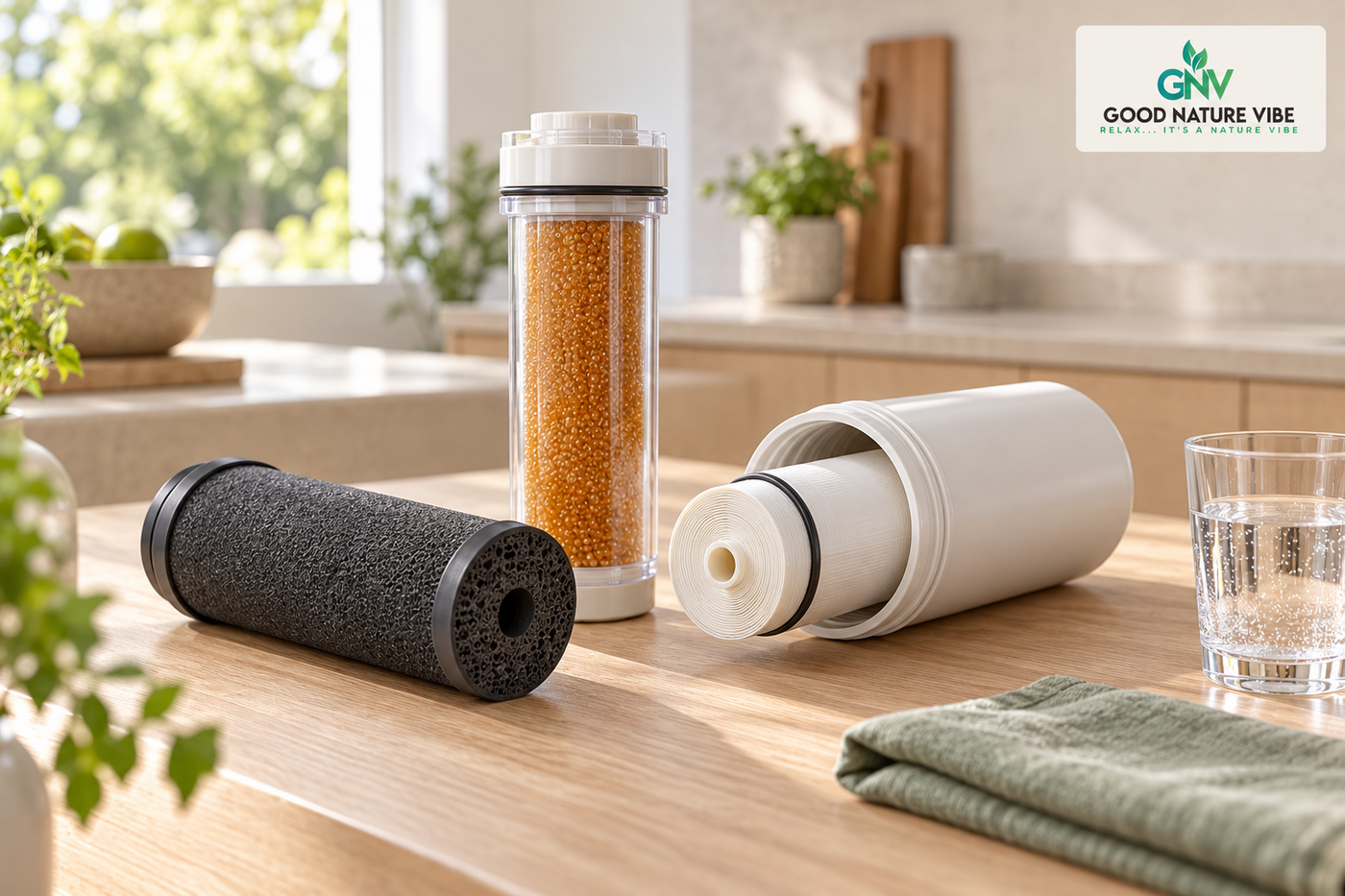
Activated carbon provides a porous surface to which certain substances can attach. This is called adsorption. Water passes through or alongside the material, and some PFAS can be retained.
The EPA explains that longer-chain PFAS such as PFOA and PFOS generally bind more effectively to granular activated carbon than some shorter-chain compounds. Contact time and other water constituents also affect performance.
For a household product, ask which PFAS the exact model has been tested to reduce. A statement that it contains carbon is not enough. The same applies to claims about better taste or less chlorine: those claims answer different questions.
Ion exchange
Ion exchange uses a resin designed to bind certain dissolved, charged substances. Suitable resin and an appropriate system design are important when the aim is PFAS reduction.
When comparing products, ask what role the resin performs and which substances appear in the test report. Also check how the cartridge is replaced and whether the performance claim depends on using a particular replacement component.
A combined filter may contain several materials. Ask for an explanation of the whole system rather than assuming that the presence of one material establishes the final result.
Reverse osmosis
Reverse osmosis uses pressure to move water through a membrane that separates certain dissolved substances. The system produces treated water and another stream containing rejected constituents.
Practical details matter when considering installation. Ask about required pressure, the amount of drinking water delivered, reject-water production and the replacement schedule for filters and membranes. Have the proposed connection assessed for your home.
More treatment stages do not provide a simple way to rank products. Clear documentation for a specific model is more useful than an impressive list of stages without evidence explaining their purpose.
What does a reduction percentage actually tell you?
A percentage describes the change between starting and finishing concentrations under particular conditions. It does not, on its own, tell you how much remained.
Consider a calculation rather than a study result: a 90% reduction from 100 nanograms per litre leaves 10 nanograms per litre. The same percentage starting at 10 nanograms per litre leaves 1 nanogram per litre.
When a product advertises a percentage, ask for both concentrations and the laboratory’s detection limit. Check which PFAS were measured, how much water had passed through the filter and whether the result covers the stated capacity.
A result from the first few litres is not the same as evidence about performance towards the end of use. Keep the question focused: what does the report demonstrate about the model you would actually buy?
How should you check certification?
Look for a specific PFAS-reduction claim attached to the exact product model. NSF/ANSI 53 and NSF/ANSI 58 are relevant standards, but a reference to a standard without the corresponding contaminant claim is incomplete information.
Match the product’s model number and cartridge with the certification body’s current listing. Ask which substances are covered, what capacity applies and which version of the standard was used. ‘Tested to’ a standard is not automatically equivalent to current independent certification.
Standards also change. NSF, IAPMO and WQA have agreed that products certified for PFAS reduction must meet updated effluent requirements in NSF/ANSI 53-2025 and 58-2025 by 1 January 2030. That transition makes the specific listing and version important. Avoid treating an old general statement about certification as a complete description of a current model.
Do households in the UK need an extra filter?
A general article cannot determine the needs of every household. Start with your supplier’s information and any advice relevant to your own supply.
The Drinking Water Inspectorate describes public drinking water in England and Wales as safe and of high quality. Its March 2025 PFAS guidance uses a value of 0.1 micrograms per litre for the sum of 48 named PFAS. This equals 100 nanograms per litre. That is guidance for those jurisdictions, not a universal rule for every country or every PFAS.
DWI oversight should not be treated as a promise of zero PFAS. Equally, detecting a trace in untreated source water is not the same as establishing a problem with treated water at your tap.
If you live in Scotland or Northern Ireland, consult the relevant supplier and regulator there. For a private supply, obtain advice appropriate to that source rather than applying a general statement about public supplies.
How does the Dutch situation differ?
For readers comparing countries, the RIVM reports a Dutch legal limit of 100 nanograms per litre for the sum of 20 PFAS, which Dutch drinking water meets. It also recommends 4.4 nanograms per litre expressed as PFOA equivalents.
These are different assessment methods. PFOA equivalents apply relative-potency weighting; a sum concentration does not do the same calculation. The RIVM considers continued tap-water consumption responsible. Further reduction in drinking-water sources remains important.
Country-specific values therefore need their units, substance lists and assessment method. A number copied from another jurisdiction is not enough to interpret your own supply.Our guide to PFAS in drinking water explains Dutch measurements and the distinction between legal limits and health-based advice.
Start with a clear question about your water
Before asking which filter is ‘best’, write down what you want to know. Are particular PFAS measured in your supply? Is there a local recommendation? Or is your main concern taste?
Ask your water supplier for the relevant report and the substances it covers. Check the date and whether the results concern treated drinking water or untreated source water. If a report is difficult to interpret, ask the supplier to explain what it means for your address.
This gives you a more useful starting point for discussions with a filter seller. You can ask about a specific substance and purpose instead of trying to judge a broad promise about purity.
If you use a private source, seek a source-specific assessment. Consider testing only with suitable sampling instructions and an appropriate laboratory. A casually collected bottle may not produce a meaningful comparison.
A practical checklist for comparing products
Use the same questions for each product, and keep the answers in one place. This makes missing information easier to recognise.
- Does the documentation name the exact model and replacement cartridge?
- Which PFAS were tested, and what concentrations remained?
- Which conditions and capacity does the claim cover?
- Is the independent certification current?
- What installation requirements apply to your home?
- Which components need replacement, and what do they cost?
- Are replacement parts readily available?
- What instructions apply after a period of non-use?
- How should used cartridges and other parts be disposed of?
Ask for a written answer when information is missing. Repeating a marketing statement does not resolve a question about the underlying test.
Include your own practical circumstances. Who will maintain the system? Can you access it easily? Will you remember the replacement schedule? Those questions help you choose a manageable product rather than one whose upkeep you may struggle to complete.
Make maintenance part of the decision
A filter has a limited working life. Follow the manufacturer’s time and volume limits, including instructions for whichever limit is reached first. A performance claim does not give permission to extend use beyond the specified conditions.
Record the installation date and set a reminder for the next check. Keep the manual, model number and cartridge details together. Order the correct replacement rather than relying on a similar appearance.
Follow cleaning and flushing instructions for the actual system. Before going away, check the procedure for restarting it after non-use. It is easier to prepare for that task than to guess when you return.
Taste is not a PFAS test. If you need to assess treatment performance with laboratory analysis, arrange suitable sampling and interpretation in advance. The comparison should use appropriate methods and clearly identified sampling points.
Common questions
Do ordinary water-filter jugs remove PFAS?
Some products may reduce particular PFAS, but the answer depends on the model. Check its explicit claim, evidence and instructions. A jug’s appearance or a general statement that it uses carbon does not establish a particular result.
Does boiling water remove PFAS?
No. NSF states that boiling water containing PFAS does not reduce exposure risk. Follow your water supplier’s specific instructions if an advisory applies; do not use boiling as a PFAS-treatment method.
Does a PFAS filter also reduce microplastics?
That needs separate evidence. A claim for dissolved chemicals does not establish performance for particles. Ask which sizes and test conditions an additional microplastic claim covers.
Is reverse osmosis always the best option?
You cannot rank all products from the technology name alone. Consider the exact evidence, your water information, installation requirements and ongoing care. A system should be appropriate for both the treatment aim and the household using it.
Is the most expensive filter the most effective?
Price does not establish which substances were tested or how the product will fit your use. Compare documentation and the full costs of installation, replacement parts and maintenance before deciding.
Does filtering drinking water solve PFAS pollution?
No. Household filtration treats water at one location. It does not remove the original cause of pollution or address every exposure route. Protecting water sources and reducing releases remain important wider measures.
Good Nature Vibe and clear information
Good Nature Vibe aims to make complex subjects easier to understand. With filtration claims, that means asking what was measured, what conditions applied and what the evidence leaves unanswered.
This article does not rank or endorse a particular filter. It offers a practical way to assess documentation and identify questions worth asking. Explore our environmental toxins category for related environmental topics.
The most useful information helps you make a considered choice without turning uncertainty into a promise. A supplier should be able to connect a claim to the product and conditions it actually describes.
Conclusion
A PFAS water filter can reduce certain PFAS, but performance varies with the substances, product and use. Activated carbon, ion exchange and reverse osmosis offer different approaches. The evidence for the exact model is more useful than the technology name alone.
Begin with local information about your water. Check the substances assessed, remaining concentrations, certification and maintenance requirements. Include replacement parts and installation in your comparison.
An additional filter is a decision to assess against your circumstances, not an automatic response to a headline. Clear documentation and a workable maintenance routine help you evaluate what a product can reasonably offer, while cleaner sources and reduced releases address pollution earlier in the chain.


