
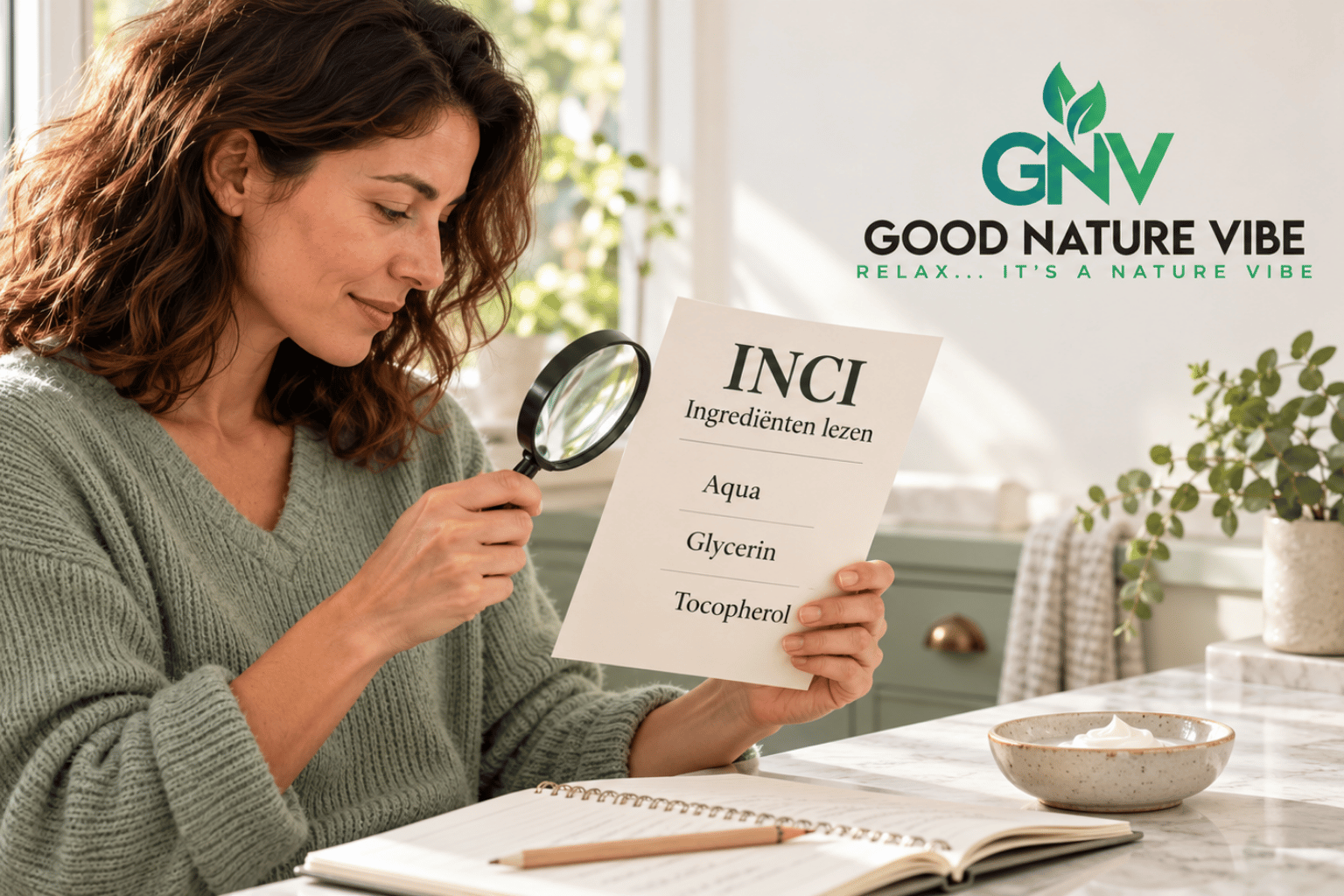
A cosmetic ingredient list identifies the ingredients declared on a label and gives clues about their order by weight. Start with the names, check what the order means, then read the directions and warnings. The list alone cannot reveal exact concentrations, prove performance or establish whether a product suits your skin.
One ingredient highlighted on the front can draw your attention away from everything else. A useful starting point is a practical question: what do you need to understand before choosing or using this product?
This guide explains European Union labelling principles for Good Nature Vibe’s English readers. Rules can differ between markets. Keep the packaging and instructions for your particular product alongside any information you find online.
What do INCI names mean?
INCI stands for International Nomenclature of Cosmetic Ingredients. It is a naming system that helps identify cosmetic ingredients consistently across different labels. The Netherlands Food and Consumer Product Safety Authority, known as the NVWA, refers readers to European ingredient information when explaining these names. (NVWA, Checklist etiketteringsverplichtingen cosmetica en spuitbussen, n.d.; accessed 2026.)
Treat a name as a starting point for identification. An unfamiliar word is not automatically a warning, and a familiar word is not proof of quality.
Copy the spelling before searching. If two names look similar, do not assume they identify the same ingredient. Keep your original label visible while checking the result.
You do not need to research every word. Start with an ingredient highlighted on the packaging, a name you want to compare or a substance you have been professionally advised to avoid.
How can CosIng help?
CosIng is the European Commission’s cosmetic ingredient information database. Search using the exact name on the label and check that the entry matches the ingredient you are researching.
The Commission explains that inclusion in the inventory does not itself authorise an ingredient for cosmetic use. The Cosmetics Regulation and its annexes establish the legal conditions. A database entry provides information; it is not an approval badge for an ingredient or product. (European Commission, Cosmetic ingredient database, n.d.; accessed 2026.)
Likewise, a listed ingredient function does not demonstrate how a finished formula performs. Keep information about an individual substance separate from evidence concerning a particular product.
What does cosmetic ingredient order tell you?
Under EU rules, ingredients are generally listed in descending order of weight when added. Ingredients at concentrations below 1% may be listed in any order after those above 1%. Additional exceptions apply to colourants. (European Parliament and Council, Regulation (EC) No 1223/2009 on cosmetic products, Article 19, 2009.)
This gives you a framework for reading the list, rather than a complete recipe. Consider this fictional opening:
Ingredients: Aqua, Glycerin, …
You can identify two names and their positions. You cannot calculate their percentages from that opening. The list also does not mark where the ingredients below 1% begin.
Write down what you actually see. If a percentage is absent, record “not stated” rather than estimating it from another formula or an online example.
Does a low position mean an ingredient is ineffective?
Position alone does not establish whether an amount is appropriate for a particular purpose. That question requires additional information about the ingredient, the formula and the specific statement being assessed.
Compare these notes:
- Observation: “The ingredient appears near the end; no percentage is stated.”
- Unsupported conclusion: “There is too little to do anything.”
The first describes available information. The second adds a judgement about performance that the list does not support.

How do you read a cosmetic ingredient list step by step?
1. Find the complete list
Start with the packaging you have. Use the product page as supporting information. A photograph from another retailer may show a different product version.
Photograph the list and keep the product name and batch reference with it. If the website and packaging differ, ask which information applies to your item. Do not combine both lists into a formula of your own.
2. Choose which ingredient names to check
Write a question beside each selected name. For example: “Which ingredient is this?”, “Is its percentage available?” or “Does this match the name on the other product?”
A focused question makes research easier to assess. A long ingredient description may still leave your original question unanswered. Save the relevant explanation and its source, rather than collecting unrelated claims.
3. Read the order without inventing quantities
Note the first ingredients and any concentration information provided. If a percentage appears elsewhere, check exactly what it describes and whether it belongs to the same product version.
Do not use a competitor’s percentage to fill a gap. Similar names or positions do not supply missing figures for your product. Leave gaps visible until suitable information resolves them.
4. Connect the list with the product’s purpose
When comparing skincare, record the product form and intended use before comparing ingredient names. Are you examining two cleansers, two oils or products used at different steps in a routine?
Then read the directions for each product. Separate questions about composition from questions about application. The ingredient list cannot answer every question about how a product should be used.
What should you read alongside the ingredient list?
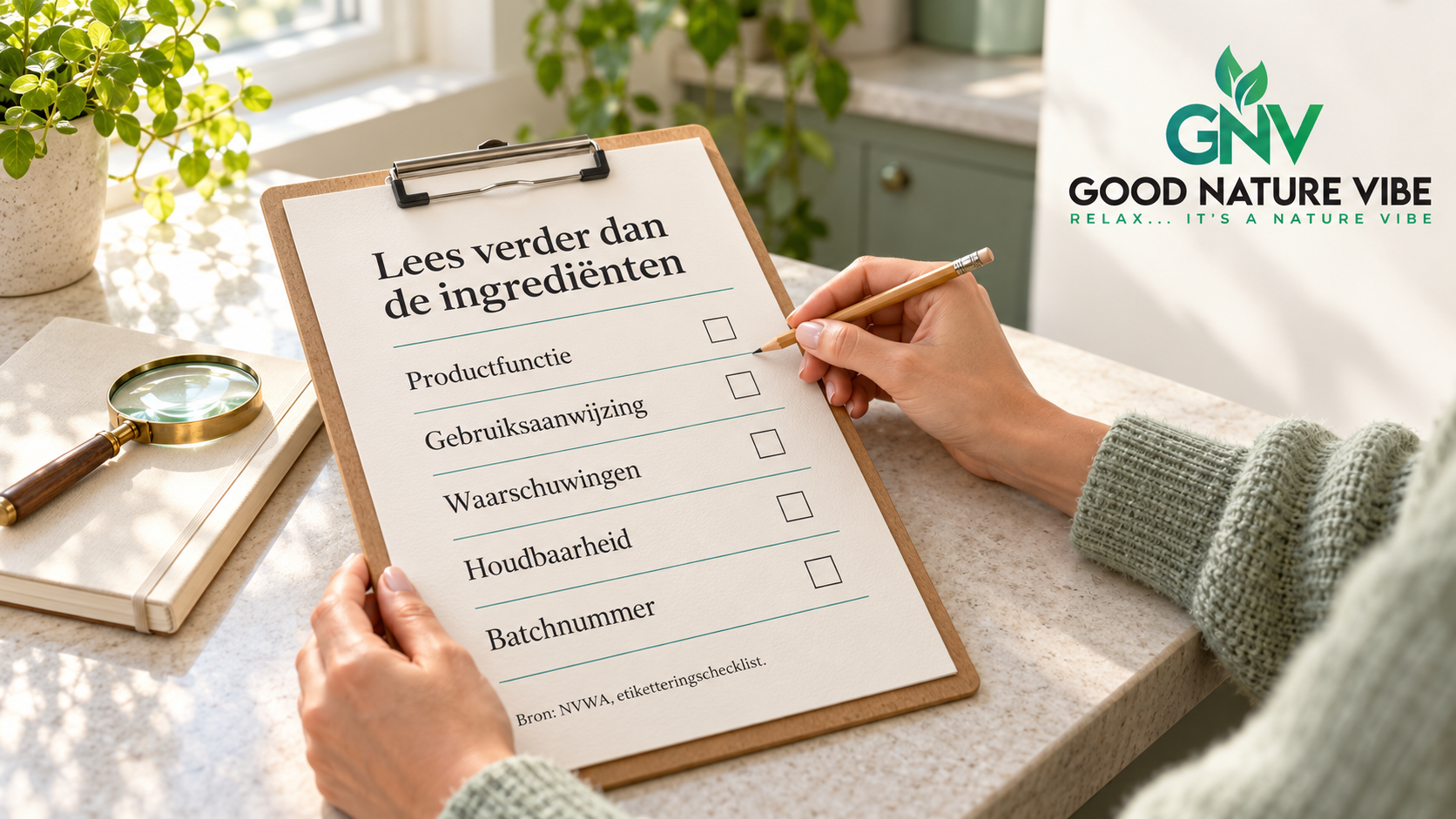
The NVWA’s labelling checklist includes contents, durability and batch identification, with instructions and precautions where needed. The product’s function must be clear when it is not apparent from its presentation. (NVWA, Checklist etiketteringsverplichtingen cosmetica en spuitbussen, n.d.; accessed 2026.)
Use these practical questions:
| Label detail | Question to ask |
|---|---|
| Product function | What is this intended for? |
| Directions | How and where should it be used? |
| Warnings | Which precautions are stated? |
| Durability | What expiry date or period after opening is stated? |
| Batch reference | Which code identifies my item? |
| Contents | How much product is supplied? |
An open-jar symbol marked 12M indicates a period of twelve months after opening. It does not tell you how often to apply the product. Consider recording the opening date so you can refer back to it. (NVWA, Klachten door cosmetica voorkomen: tips voor consumenten, n.d.; accessed 2026.)
If you discard an outer carton, first photograph instructions you will need later. Keep the information linked to the correct product, especially when several similar items share a shelf.
What can an ingredient list not establish?
Exact concentrations
A name without a percentage does not supply an exact amount. Its position cannot turn that missing figure into a calculation. Ask for clarification if concentration is central to your comparison.
Finished product performance
An ingredient list is not a product test report. When you find research about one substance, first decide whether your question concerns that substance or the finished cosmetic.
For a specific product statement, ask which evidence supports it. Record what was tested, how it was assessed and which outcome was reported. A general reference to research leaves those details unresolved.
Personal suitability
The NVWA explains that irritation or allergic reactions can occur even with cosmetics that meet the rules. Reading a list therefore cannot guarantee your individual response. For a known allergy, use appropriate professional guidance rather than relying on a general online assessment. (NVWA, Klachten door cosmetica voorkomen: tips voor consumenten, n.d.; accessed 2026.)
Sourcing and production records
An ingredient name does not contain a complete account of the supplier, manufacturing process or batch testing. Ask which documents are available when a sourcing or testing statement matters to your decision.
Overall quality
Do not rank formulas solely by ingredient count. A shorter list does not prove better quality, and a longer list does not prove worse quality. Identify which information would support the particular judgement you want to make.
How can you compare two products fairly?
Use the same questions for both products. The following fictional examples illustrate differences in available information. They are not recommendations.
| Information | Product A | Product B |
|---|---|---|
| Highlighted ingredient | Name stated | Name and percentage stated |
| Complete ingredient list | Available | Available |
| Directions | Clear on packaging | Not shown on the product page reviewed |
| Testing statement | “Tested” only | Report describing the test available |
Product B provides a percentage in this example. That makes one detail more specific; it does not establish better performance. Product A has clearer directions in the material examined. Ask where the missing instructions for Product B can be found.
Next, read the report to understand which question it addresses. Do not assume that one documented test supports every phrase on the product page. Record what the test covered before drawing a conclusion.
Separate information from preferences
Make two columns in your notes. Use one for details you can verify: names, stated percentages, directions and available documents. Use the other for preferences such as product format, packaging or the simplicity of your routine.
“I prefer using an oil” is a preference. “Oil is better” needs a defined comparison and supporting evidence. Keeping those statements apart makes your decision easier to explain.
For additional reading about interpreting evidence, our article on tap water vs bottled water considers a different subject where methods and context matter. Its findings concern drinking water, not water used in cosmetic formulas.
Keep a useful record
Add the date and the place where you found the information. Save a screenshot when it helps establish which wording you reviewed. Include the product name so that individual details do not become attached to another item.
Use three simple labels: “stated”, “requested” and “unknown”. “Requested” means you are waiting for clarification. “Unknown” describes an information gap, not an automatic product failure.
Before deciding, return to your original question. Which missing detail matters most? This prevents a growing collection of search results from making a straightforward comparison unnecessarily complicated.
What should you ask when information is missing?
Choose questions that invite a specific answer:
- Which ingredient list applies to my product and batch?
- Where can I find the full directions?
- Is the highlighted ingredient’s percentage available?
- What was examined when the product was described as tested?
- Which document supports this particular statement?
Send a clear photograph and the product name. Keep the reply beside your notes. If a detail remains unresolved, label it “unconfirmed” instead of filling the gap yourself.
If you develop skin complaints or other health problems after cosmetic use, the NVWA recommends contacting a doctor. An ingredient search cannot diagnose the cause. (NVWA, Klachten door cosmetica voorkomen: tips voor consumenten, n.d.; accessed 2026.)
Frequently asked questions
What does INCI mean on cosmetics?
INCI stands for International Nomenclature of Cosmetic Ingredients. It helps identify cosmetic ingredients consistently across different labels.
Are ingredients always listed from highest to lowest amount?
Under EU rules, ingredients are generally listed in descending order of weight when added. Ingredients at concentrations below 1% may be listed in any order after those above 1%. Additional exceptions apply to colourants.
Can I calculate a percentage from ingredient order?
No. The list does not provide exact percentages or identify where the ingredients below 1% begin. Ask for product-specific information when a concentration matters.
Does a CosIng entry mean an ingredient is approved?
No. CosIng is an information database. The Cosmetics Regulation and its annexes determine whether and under which conditions a substance may be used.
Is a shorter ingredient list better?
Ingredient count alone cannot establish quality. Compare the complete product information, directions and evidence behind specific statements.
How does Good Nature Vibe approach product information?
Good Nature Vibe describes its approach to product quality through composition, documentation and clear limits on claims. For skincare, its published approach calls for readable ingredient information, contents and directions. Reports are mentioned when available and relevant.
This supports a practical habit: examine concrete information and ask focused questions about anything missing. (Good Nature Vibe, Our quality approach, n.d.; accessed 2026.)
Conclusion
Start with the complete list, identify unfamiliar names and interpret their order within the labelling rules. Read the instructions, warnings and durability information alongside it. Keep observations separate from assumptions. A cosmetic ingredient list is a useful starting point for informed questions, rather than a complete assessment of performance or personal suitability.


