
Questions about PFAS water contamination are understandable. Are these substances present in Dutch tap water? How much is detected? And does finding a very small concentration automatically mean that the water is unsafe? Responsible answers require more context than a headline or a single laboratory result can provide.
PFAS can enter groundwater and surface water, both of which are used to produce drinking water in the Netherlands. Water companies treat the source water and monitor its quality before it reaches households. However, PFAS is a broad group of substances, and not every compound is equally easy to remove. Dutch government information states that tap water may contain small amounts of PFAS but can still be consumed normally.
This article explains how PFAS reach drinking-water sources, why the origin of the water matters, what Dutch monitoring can and cannot tell us, and how legal requirements differ from health-based guidance. It also looks at bottled water, household filters and practical ways to find reliable local information.
What are PFAS and why do they enter water?
PFAS stands for per- and polyfluoroalkyl substances. It is a collective term for a large and varied group of human-made chemicals. Different PFAS have been used because they can resist water, grease, dirt or heat. Applications have included industrial processes, some firefighting foams, textiles, coatings, packaging and other materials.
Many PFAS contain exceptionally strong carbon-fluorine bonds. As a result, a number of these substances break down very slowly in the environment. If they are released during production, use or waste treatment, they can travel through air, soil and water. Some PFAS move relatively easily with water, while others are more likely to accumulate in organisms or food chains.
The phrase “forever chemicals” refers to this persistence, which is why PFAS in water has become an important monitoring issue. The label does not, however, tell us how much of a particular substance is present or what a specific exposure means for health. A careful assessment must consider the individual compound, concentration, duration and route of exposure, as well as exposure from other sources.
It is therefore useful to separate three ideas. Detection means that an analytical method has found a substance above its reporting threshold. Exposure describes how much may enter the body and over what period. Risk assessment considers exposure alongside evidence about potential effects. These concepts are connected, but they are not interchangeable.
How do PFAS reach Dutch drinking-water sources?
Dutch water companies use groundwater, surface water and, to a smaller extent, other sources to make drinking water. PFAS may reach those sources through industrial emissions, wastewater, waste streams, the use and disposal of PFAS-containing materials, and historical use of firefighting foam. Even substances that have been restricted for years may remain in the environment because they degrade slowly.
Surface water from rivers such as the Rhine and Meuse comes from large international catchments. A substance measured near a Dutch intake point may therefore originate from activity much further upstream. Rainwater runoff, treated wastewater and industrial discharges can all influence river-water quality.
Groundwater receives more protection from soil layers, but it is not completely isolated. Local soil contamination, industrial sites, waste disposal or older emissions can affect groundwater. Once persistent chemicals reach a deep groundwater body, natural recovery can take a long time.
For this reason, water management extends beyond testing water at the household tap. Authorities and water companies also monitor sources, abstraction points and trends over time. Source-water information helps determine which treatment and risk-management measures are appropriate.
Groundwater and surface water: why the source matters
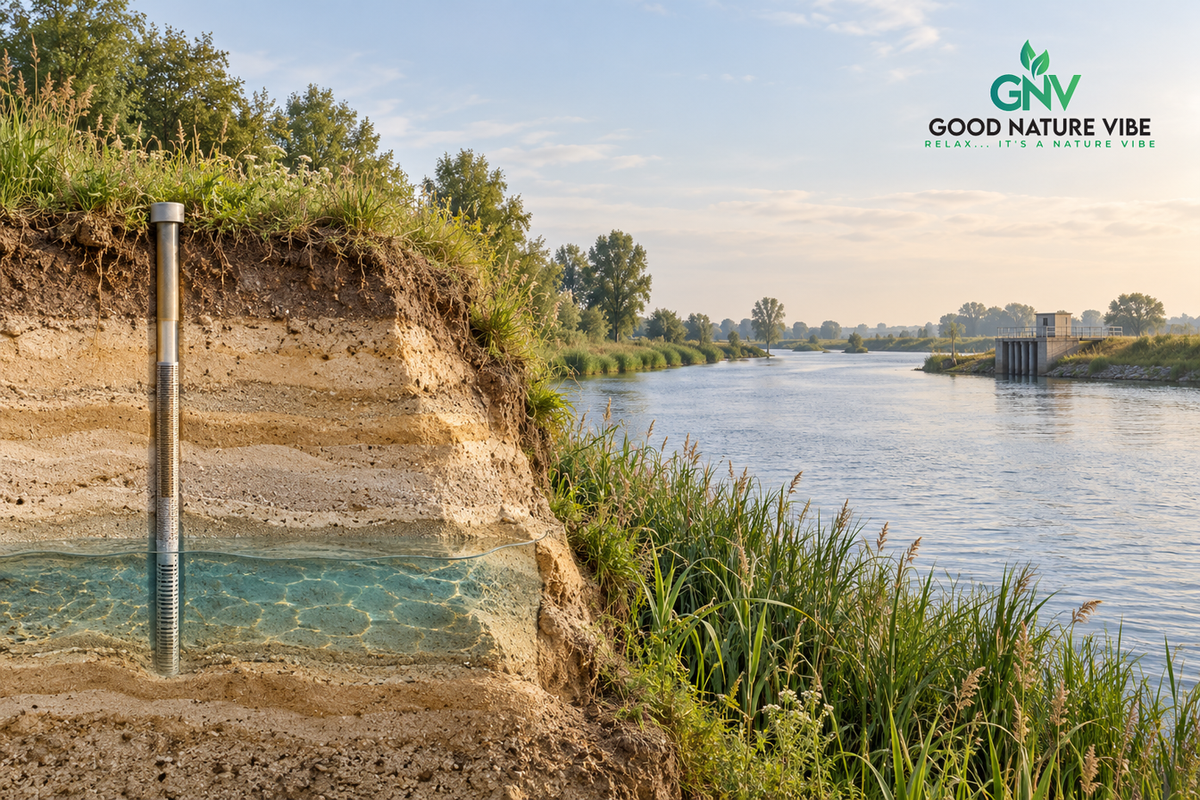
RIVM reports that roughly 60 per cent of Dutch drinking water is produced from groundwater. On average, drinking water made from groundwater contains less PFAS than water produced from surface water. This is a general pattern, not a guarantee for every location.
Surface water is more directly exposed to discharges and pollution within its catchment. It often requires several treatment stages. Groundwater has benefited from natural passage through soil, but its quality can still be affected by local contamination and by substances that migrate through the ground.
The final tap-water composition cannot be reduced to a simple provincial map. One water company may operate several sources and treatment plants. The water supplied to neighbouring areas may therefore have different origins. Consumers who want to understand their own supply should check the postcode tool or quality report published by their water company.
This is why national averages should not be treated as a precise description of every tap. Local reports are more relevant for a particular supply zone.
Are PFAS present in Dutch tap water?
Small amounts of PFAS can be measured in Dutch drinking water. That answer needs context. Modern laboratories can detect chemicals at extremely low concentrations. The presence of a measurable amount is not, on its own, proof that the concentration causes a health effect.
RIVM combines monitoring information with consumption data and health-based guidance when assessing exposure. In its 2023 assessment, the estimated average intake from drinking water alone was below the health-based guidance value. However, average exposure from food and drinking water together was above that value.
The Dutch Government consequently explains that tap water can contain small amounts of PFAS while still being suitable for normal consumption. At the same time, reducing PFAS in water sources remains important. These positions are not contradictory. Water may comply with applicable requirements while further reductions in emissions and concentrations are still desirable.
The distinction also avoids two unhelpful extremes: claiming that any detection proves immediate danger, or assuming that compliance means no further action is needed. Monitoring, source protection and technical improvements can all remain necessary even where supplied water meets current requirements.
What do monitoring results tell us?

The Dutch Human Environment and Transport Inspectorate, known as ILT, supervises drinking-water quality. Its 2024 report states that 99.84 per cent of measurements within the statutory monitoring programme met the applicable quality requirements. This figure concerns drinking-water quality as a whole; it is not a PFAS-specific compliance rate.
The figure indicates a high level of compliance with the applicable statutory requirements. ILT also notes growing pressure on the system. Pollution of sources, climate change and ageing infrastructure can make maintaining that standard more difficult.
For PFAS, the details of the measurement programme matter. The PFAS family contains many compounds, while analytical methods and reporting limits continue to develop. A study examining four familiar PFAS does not answer the same question as a method covering a much larger group. Results should only be compared when the compounds, units, sampling periods and analytical approaches are compatible.
A value reported as “below the reporting limit” does not necessarily prove absolute absence. It means the laboratory could not quantify the substance above the stated threshold using that method. Conversely, a detectable result needs to be interpreted against the relevant standard or guidance value rather than treated as a conclusion on its own.
Legal limits and health-based guidance values
Terms such as limit, standard, parameter value and advisory value are often used as though they mean the same thing. They do not always serve the same purpose.
A statutory limit is established in law and can be used for compliance and enforcement. A health-based guidance value is derived from toxicological and exposure evidence to support public-health assessment. It may be more stringent than the legally enforceable requirement in force at a given time.
Different frameworks may also cover different groups of PFAS. A parameter for the sum of 20 selected compounds is not equivalent to an assessment that converts several PFAS into equivalents based on relative potency. The number alone does not reveal how broad or precautionary the underlying method is.
This explains why a news report may state that water meets a legal standard while also discussing a stricter advisory value. Both statements may be accurate because they answer different questions. Readers should check who established the value, its intended purpose, which PFAS are included, the unit used, and whether the sample came from source water or treated drinking water.
Exposure through drinking water compared with food
Drinking water is not the only route of PFAS exposure. RIVM's 2023 assessment concluded that people in the Netherlands receive, on average, more than three times as much PFAS through food as through drinking water. Fish was an important food source in that assessment, alongside contributions from other foods.
This comparison does not make PFAS in drinking water irrelevant. Water is consumed daily, and protecting clean drinking-water sources is an important public responsibility. The comparison simply prevents the tap from becoming the sole focus when overall exposure comes from several routes.
It is also unrealistic to promise that changing one product or source will eliminate an individual's total PFAS exposure. These chemicals are widespread in the environment. Policies that reduce production, use and emissions can address several exposure routes at the same time and are more meaningful than shifting the entire responsibility to consumers.
How do water companies reduce PFAS?
The appropriate treatment depends on the source water, the PFAS present and their concentrations. Water companies use combinations of processes to reduce unwanted substances. Activated carbon can adsorb various PFAS. Membrane technologies such as reverse osmosis can also achieve substantial reductions, although they require energy and create a concentrated residual stream. Ion exchange may be used or investigated depending on the application.
Not all PFAS behave in the same way. Longer-chain compounds are often retained more effectively by activated carbon than shorter-chain PFAS. Performance can also decline as the filter material becomes saturated, meaning that it must be replaced or regenerated at the correct time.
Treatment is therefore not a simple end-of-pipe solution. It costs money and energy, and captured PFAS must be managed in a residual material or wastewater stream. Preventing releases and protecting sources remain essential even when treatment technology improves.
Is bottled water a better alternative?
Bottled water cannot be assumed to contain less PFAS in every situation. RIVM notes that, on average, drinking water made from surface water can contain more PFAS than bottled water, but the difference depends on the water source. Its composition depends on the source, treatment, producer and sampling date. Natural-looking packaging is not evidence that PFAS are absent.
Bottled water also involves other considerations, including packaging, transport, storage and cost. Changing to bottled water because of general concern does not guarantee that PFAS intake will fall unless reliable, product-specific test results support that conclusion.
Simple comparisons can also be misleading for other small environmental particles. For related context, read our article on microplastics in water, food and air. Choices are best based on current local water information and verifiable product data rather than broad marketing claims.
Can a household water filter help?
A household filter may reduce certain PFAS further, but not every device is designed or independently tested for that purpose. Activated carbon, reverse osmosis and ion exchange can be relevant. Actual performance depends on the model, PFAS tested, water chemistry, flow rate, capacity and timely maintenance.
A certification for taste, odour or chlorine does not demonstrate PFAS reduction. Consumers should look for independent testing of the exact model against a clearly defined PFOA, PFOS or broader PFAS claim. The test should state the capacity over which the claimed performance is maintained.
No household filter should be assumed to remove every PFAS completely. Poor maintenance can also reduce performance. A filter may be a personal additional step for someone seeking further reduction, but it is not a substitute for source protection, official monitoring or action by water suppliers and regulators.
Where a private well or a confirmed local incident is involved, targeted laboratory analysis and advice from the responsible authority are more appropriate than buying an unverified filter at random.For more detail on filter technologies, testing and maintenance, read our guide to choosing a PFAS water filter.
What can consumers do in practice?

Start with information about your own water supply. Check the website or quality report of your water company and look for current local notices. If an official warning is issued, follow the instructions from the supplier, municipality, safety authority or public-health service.
If you use a private water source, arrange appropriate laboratory testing. Many simple home water-testing kits are not designed to measure PFAS reliably at the low concentrations relevant to drinking-water assessment. Before sampling, confirm which compounds, reporting limits and methods the laboratory will use.
Treat claims such as “detox”, “100% PFAS-free” or “complete removal” with caution unless they are supported by product-specific evidence. A reduction percentage only makes sense in relation to a stated test method, capacity and use condition.
Avoid making major decisions from a single screenshot or isolated figure. Check the date, unit, sample type, compounds included and comparison value. For more evidence-conscious environmental and wellbeing content, explore the Good Nature Vibe blog.
Frequently asked questions about PFAS in drinking water
Is Dutch tap water safe to drink?
Dutch Government guidance states that Dutch tap water can be consumed normally, although small amounts of PFAS may be present. Drinking-water quality is monitored, while further reduction of PFAS in source waters remains important.
Does all Dutch tap water contain the same amount of PFAS?
No. Concentrations can vary with the source, local pressures and treatment process. On average, drinking water made from groundwater contains less PFAS than water produced from surface water, but local data remain important.
Can boiling remove PFAS from water?
Boiling does not reduce PFAS concentrations in water and is therefore not a reliable PFAS-removal method.
Where can I find results for my area?
Consult the quality information published by your water company. If you have a specific concern, contact the supplier directly. Current local instructions from public authorities take priority over general online advice.
Does a low result mean that there is no risk at all?
A result must be interpreted in relation to the compound, duration of exposure, assessment value and exposure from other routes. A single number is not enough to reach a personal health conclusion.
Good Nature Vibe: clarity without false certainty
Good Nature Vibe takes a measured approach to PFAS. Detectable environmental contamination deserves effective source control, reliable monitoring and transparent communication. At the same time, presenting every detection as an immediate personal threat does not help readers make informed choices.
Look at the water source, analytical method, unit and assessment value. Prefer evidence that can be checked, and be cautious of products that promise more certainty than the research supports. Explore our health news category for more articles on environmental research and wellbeing.
Conclusion: What the evidence says about Dutch tap water
PFAS can be present in Dutch drinking-water sources and can be measured in small amounts in tap water. Concentrations vary with the source and treatment. Drinking water produced from groundwater contains less PFAS on average than water made from surface water, although local conditions remain decisive.
RIVM's assessment found that average PFAS intake from drinking water alone was below the health-based guidance value. It also found that average exposure through food was more than three times exposure through drinking water. Dutch Government guidance states that tap water can continue to be consumed normally. ILT's 2024 monitoring report found very high overall compliance with statutory drinking-water requirements, although that figure should not be presented as a PFAS-specific result.
None of this means PFAS pollution can be ignored. Treatment becomes more complex and expensive once persistent substances enter groundwater and rivers. Source protection, lower emissions, effective monitoring, transparent reporting and continued improvement in treatment therefore remain essential.


