

PFAS appear in news about Dutch drinking water, food, soil and everyday products. They are often called forever chemicals, a name that draws attention to their persistence. Yet a short headline rarely explains which substances were measured, how people might encounter them or what a result means for daily life.
PFAS are a large family of manufactured chemicals, rather than one ingredient with one set of properties. Some members have been studied extensively; others are less well understood. Their behaviour, uses and potential effects differ. Understanding those distinctions makes it easier to read a water report, assess a product statement or follow local advice.
This article explains the PFAS meaning, why these substances have been used and where they can occur in the Netherlands. It also separates environmental presence from personal exposure and health risk. The aim is to give you useful context for sensible choices, without turning every household item into a cause for concern.
What are PFAS?
PFAS stands for per- and polyfluoroalkyl substances. These are synthetic chemicals with structures that include carbon–fluorine bonds. Those bonds help explain why many PFAS resist breakdown and can remain in the environment for a long time.
Examples include PFOA and PFOS, as well as substances associated with GenX technology. These names describe different chemicals or groups; they are not interchangeable labels. A study concerning PFOA does not automatically describe every other PFAS equally well.
The family includes substances with different sizes and structures. Some move relatively readily through water, while others may behave differently in soil or living organisms. Certain PFAS can accumulate in the body. How much remains, and for how long, depends on the particular substance and the circumstances of exposure.
A useful starting point is therefore to ask what a report actually covers. Is it describing one named compound, a selected group or a wider screening method? The answer affects how the results should be interpreted. “PFAS detected” is a starting point for explanation, rather than a complete conclusion.
Why are they called forever chemicals?
The nickname refers to persistence. Many PFAS break down very slowly, which means pollution can outlast the activity that originally released it. A former industrial use may remain relevant to present-day monitoring even when that particular use has stopped.
The expression is memorable, but it simplifies a complicated family. It does not mean that every PFAS behaves identically, stays indefinitely in every part of the body or presents the same risk. Persistence in the environment and retention in a person are related questions that require different evidence.
When reading an article, notice whether the author moves from the broad nickname to specific findings. A clear explanation should identify the substances and setting wherever possible. Otherwise, a statement about one measured compound can easily sound like a statement about the whole family.
Why have PFAS been used?
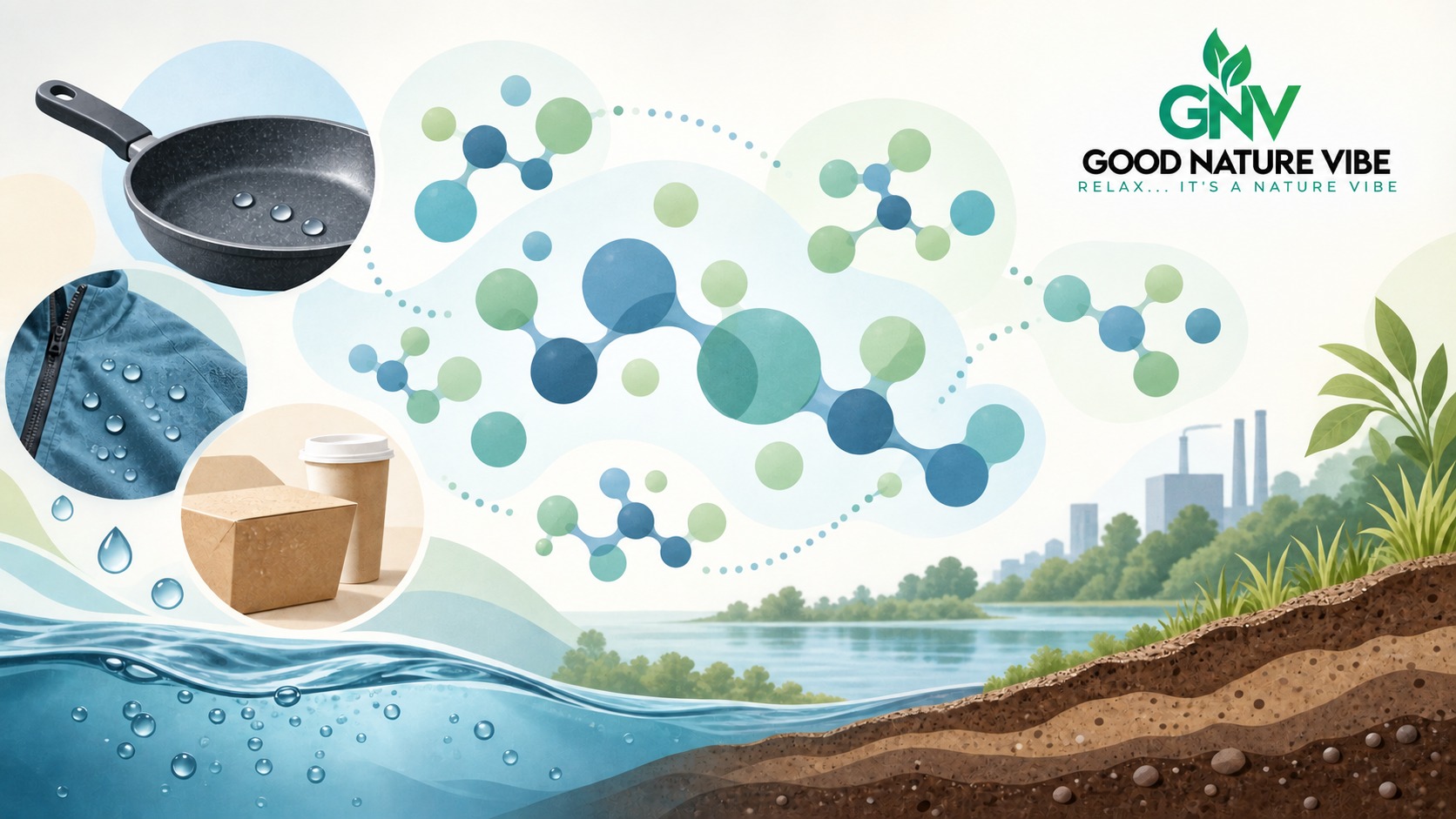
Some PFAS provide resistance to water, grease, dirt or heat. These properties have made them useful in particular coatings, textile treatments, firefighting foams and industrial processes. Their use has extended beyond familiar consumer products to technical applications.
Those useful properties also create a long-term problem when persistent substances enter the environment. Releases can occur during production, use or disposal. Once contamination is spread through water or soil, controlling it can be difficult and expensive.
A product's appearance does not reveal its ingredients. A water-repellent jacket does not automatically contain PFAS, and a grease-resistant package cannot be assessed simply by looking at it. Manufacturers use different formulations, and these change over time.
For a specific purchase, product documentation is more helpful than a general list of potentially relevant categories. Ask about the exact model and current formulation. A statement about an older version may not describe the item now on sale.
Where can PFAS occur?
PFAS can reach soil, surface water and groundwater through industrial releases, waste streams, product use and historical contamination. From there, some can enter food chains. The place where a chemical was used and the place where it is later measured need not be the same.
People may encounter PFAS through food, drinking water, household dust and certain materials. The relative importance of these routes varies. A finding in one product cannot establish someone's total exposure across all sources.
Questions about microplastics also involve water, food and other exposure routes. However, plastic particles and PFAS are different topics. A method that measures particles does not necessarily measure dissolved PFAS, and evidence about one should not be presented as proof about the other.
When comparing findings, begin with the sample: soil, river water, finished tap water, food or blood. Then check the substances, units and location. These details prevent a dramatic measurement from being applied to a situation the study did not investigate.
PFAS in food

Environmental contamination can reach food through soil, water or animal feed. Concentrations can vary with location, production conditions, species and the substances measured. A result from one site does not describe every product in the same food group.
EFSA's 2020 assessment set a group tolerable weekly intake of 4.4 nanograms per kilogram of body weight per week for four PFAS: PFOA, PFOS, PFNA and PFHxS. Reduced immune response to vaccination was the critical effect used to establish this value. It is a long-term exposure benchmark, not a test that diagnoses illness after a meal.
For perspective, the distinction between a concentration and an intake matters. A laboratory might report nanograms in a quantity of food, whereas an exposure assessment also considers how much is eaten and body weight. Comparing numbers without their units can produce misleading conclusions.
Lists of “foods containing PFAS” are therefore incomplete unless they explain the evidence and context. They should not become a reason to remove entire food groups without specific official advice. A varied diet remains the practical starting point in the supplied Dutch guidance.
PFAS in drinking water

PFAS may enter drinking-water sources through contaminated soil, rivers or groundwater. A sample from a river is different from a sample of treated water leaving a waterworks or reaching a household tap. Reports should say clearly which stage was tested.
RIVM states that Dutch drinking water meets the legal limit of 100 nanograms per litre for a sum of 20 PFAS. It recommends a stricter guideline of 4.4 nanograms per litre expressed as PFOA equivalents. These values use different assessment methods and cannot be compared as identical measures. Dutch guidance remains that tap water can be drunk.
RIVM's 2023 assessment found average food exposure about three times that from drinking water. Combined exposure exceeded the health-based guidance value; water alone was below it. These are population estimates, rather than measurements of your individual intake.
The distinction between compliance and reducing exposure is important. Meeting a legal standard does not mean that no PFAS are present. At the same time, a recommendation to reduce pollution does not automatically mean residents should stop using their tap water.
For local information, consult the water supplier's current quality report. Check the supply area, sampling date and substances covered. If a specific advisory applies, follow its actual instructions rather than assuming a national article describes every local situation.Our article on PFAS in drinking water explores the Dutch tap-water context in more detail.
PFAS in everyday materials
Certain PFAS have been used in coatings, treated textiles and other materials because of their functional properties. This describes possible applications, not a verified inventory of the contents of your home.
The wording of a product claim matters. “PFOA-free” addresses one particular compound; it does not establish that the product contains no other PFAS. A broader statement should explain its scope and supporting information.
You can ask whether a claim covers the coating, the whole finished item or only substances intentionally added during manufacturing. These are different questions. A seller should be able to explain what its wording means instead of relying on a reassuring badge alone.
Avoid replacing useful items simply because they belong to a category mentioned in a news story. Read the manufacturer's care instructions, assess the item's condition and seek reliable information about the particular product. Purchase decisions can then reflect your preferences and the available evidence.
What do Dutch authorities investigate?
Different organisations answer different questions. RIVM assesses health and environmental risks. The NVWA works on food safety. Drinking-water organisations monitor supplies and treatment, while government bodies develop policy and respond to particular contamination problems.
Their publications should be read according to purpose. A scientific assessment may estimate exposure across a population. A local notice may specify action for a particular area. A product investigation may cover a limited set of samples. Each can be useful without answering every PFAS question.
Regulation also requires careful wording. A proposal, an adopted restriction and a rule that has started to apply are different stages. Some PFAS uses are already restricted, while broader European measures have been under development. Do not interpret that as a blanket statement that all PFAS applications have ended.
For the latest position, check the authority, date and precise scope. An undated summary cannot establish what is permitted today. Nor does compliance with one restriction establish the composition of every product sold under a familiar description.
How should PFAS health effects be understood?
Health evidence depends on the substance, the amount and duration of exposure, and the outcome being studied. A general statement about PFAS cannot calculate the health implications of one purchase, one meal or a particular person's water consumption.
Research includes laboratory studies, animal studies and observations in people. These approaches offer different kinds of evidence. An association observed in a population needs interpretation alongside exposure estimates, other possible influences and the wider research picture.
There is an important difference between identifying a hazardous property and estimating risk in a particular situation. The first asks whether a substance can cause harm under certain conditions. The second considers whether and how people are exposed in the setting being assessed.
A health-based guidance value supports that assessment. Exceeding it over time is a reason to reduce exposure; it is not a diagnosis. Equally, uncertainty should not be treated as proof that no action is needed. Authorities use evidence and precaution to guide monitoring and prevention.
If a personal concern relates to a known exposure incident, contact a GP or the local public health service. Provide the actual report or advisory if you have one. A general online article cannot establish your exposure history or interpret a medical test.
Practical steps you can take
Start with advice that applies to your location
Look for current notices from the municipality, public health service, food authority or water supplier. Read the geographic area and the activity concerned. Advice about produce from a contaminated site should not automatically be extended to all shop-bought food.
If a notice is unclear, ask the issuing authority what it covers. This is especially useful when a recommendation concerns a specific garden, fishing location or local product. Sharing the original notice also helps avoid losing essential qualifications when discussing it with others.
Keep food choices varied
A varied diet avoids depending heavily on a narrow selection of foods. Follow specific official recommendations when they apply, but avoid constructing a restrictive diet from isolated measurements or social-media lists.
A useful question is whether the information concerns a particular place or an entire food category. Another is whether the advice comes from a risk assessor or someone promoting an alternative product. That distinction can change the practical meaning of the message.
Ask clearer questions before buying
When PFAS matters to a purchase, request a written statement for the exact product. Ask what “free from” means, which parts of the item are covered and whether the information is current.
Keep the answer alongside the model name or product code. This makes comparisons easier and avoids assuming that similar items share a formulation. You do not need a chemistry degree to ask a supplier for precise, understandable documentation.
Use and maintain products as instructed
Follow the care instructions for cookware, coatings and treated materials. A product's intended temperature, cleaning method and condition are relevant to proper use. An online claim should not override the manufacturer's safety instructions.
Replacement is best considered with specific information about damage or suitability. Buying a different material may fit your preferences, but it does not justify a promise that your total PFAS exposure will fall by a known amount.
Examine filter and detox claims carefully
A water-filter claim needs evidence for the exact system and substances tested, as well as maintenance requirements. A large removal percentage without the starting concentration, testing conditions or cartridge lifetime tells only part of the story.
Promises to “detox” PFAS from the body require particular caution. A claim that sounds scientific is not the same as a demonstrated outcome. Do not treat a supplement or wellness product as a substitute for public-health advice about a known exposure problem.
Frequently asked questions
What are PFAS exactly?
PFAS are a broad family of manufactured chemicals. Different members have different structures and uses. Many are persistent, which helps explain why environmental contamination remains a concern long after release.
Does forever chemicals mean all PFAS are identical?
No. The nickname describes persistence in broad terms. It does not establish identical toxicity, mobility or retention in the body. Findings should identify the compounds or group actually assessed.
Where are PFAS found?
They can occur in soil, water, food and certain materials. Being in a product category associated with PFAS does not prove that every item contains them. The precise product and evidence matter.
Can I continue drinking Dutch tap water?
Current Dutch guidance supports drinking tap water. Consult the water supplier for local quality information and follow any specific official advisory that applies to your area.
Can a label prove a product contains no PFAS?
A claim needs a clear scope. “PFOA-free” concerns PFOA rather than the whole family. Ask for information about the exact item and how the manufacturer supports a broader PFAS claim.
Can exposure be eliminated completely?
Complete avoidance is not realistic given environmental spread. Sensible actions include following relevant official advice, varying food choices and checking product information without assuming guaranteed reductions.
Good Nature Vibe and clear information
Good Nature Vibe aims to make environmental topics understandable. With PFAS, useful information connects a finding to its setting: which substances were measured, what the result describes and which practical conclusions the evidence supports.
Our articles encourage informed questions rather than certainty based on a single headline. They distinguish broad environmental issues from individual medical questions and keep product claims separate from scientific findings.
Explore more health news in Good Nature Vibe's knowledge centre for accessible explanations of health and environmental topics.
Conclusion: understanding PFAS in the Netherlands
PFAS have been used for useful material properties, but the persistence of many members creates long-term challenges. They can spread through the environment and contribute to exposure through food, water and other routes.
The most useful response begins with context. A chemical's presence, a population exposure estimate and a personal health conclusion are different things. Clear reporting preserves those distinctions while recognising why reducing environmental releases matters.
For everyday choices, follow applicable official advice, maintain a varied diet and request specific product information. When a new PFAS story appears, check the sample, substances, units and date before deciding what it means for you.


