
PFAS in drinking water is getting more and more attention. Anyone who looks into these substances quickly comes across water filters that promise to remove PFAS. But what exactly does such a claim mean? Not every filter works the same way, not every PFAS substance reacts in the same way and no system keeps performing indefinitely without proper maintenance.
A PFAS water filter can reduce the amount of certain PFAS in water. How well that succeeds depends, among other things, on the filter material, the specific product, the composition of the water, the flow rate and the moment at which a filter cartridge is replaced. That is why it is wiser to speak of reduction than of complete removal.
In this article you will read which filtering techniques are relevant, what to look out for in product claims and why a household filter is never a substitute for tackling pollution at the source.
What are PFAS and how do they end up in drinking water?
PFAS is the collective name for a large group of man-made substances. The abbreviation stands for per- and polyfluoroalkyl substances. They have been used, among other things, for their water-, grease- and dirt-repellent properties. You can find them, for example, in industrial applications and in some coatings, textiles, packaging and firefighting foams.
The strong chemical bonds in PFAS mean that many of these substances break down only with difficulty. Through production, use, waste streams and emissions, they can end up in soil, surface water and groundwater. Drinking water companies purify the water they take in extensively, but very small amounts of PFAS can remain present in drinking water.
That does not mean Dutch tap water is suddenly unsafe. The Dutch government reports that drinking water can contain small amounts of PFAS and that you can simply keep drinking tap water. According to the RIVM, average exposure to PFAS through food is moreover greater than through drinking water. The presence of PFAS does remain an important topic for source policy, monitoring and further improvement of water quality. Our article on PFAS in the Netherlands gives more background about these substances, their applications and possible sources.
Can you filter PFAS out of drinking water?
Yes, certain filtering techniques can lower concentrations of various PFAS. The most frequently mentioned techniques are activated carbon, reverse osmosis and ion exchange. Research and practical experience show that these methods can be relevant, but a general statement like ‘this filter removes PFAS’ still tells us too little.
PFAS is not a single substance. The group includes many compounds with different properties. Longer PFAS chains are often retained more easily by activated carbon than shorter chains. Other substances in the water can also compete for available spots in the filter material. A result achieved under controlled test conditions is therefore not automatically equal to the result in every household.
A well-substantiated claim states at least which PFAS the product has been tested for, according to which standard, at what capacity and under what conditions of use. Without that information, ‘PFAS filter’ remains mainly a marketing term.
Which water filters can reduce PFAS?
Activated carbon
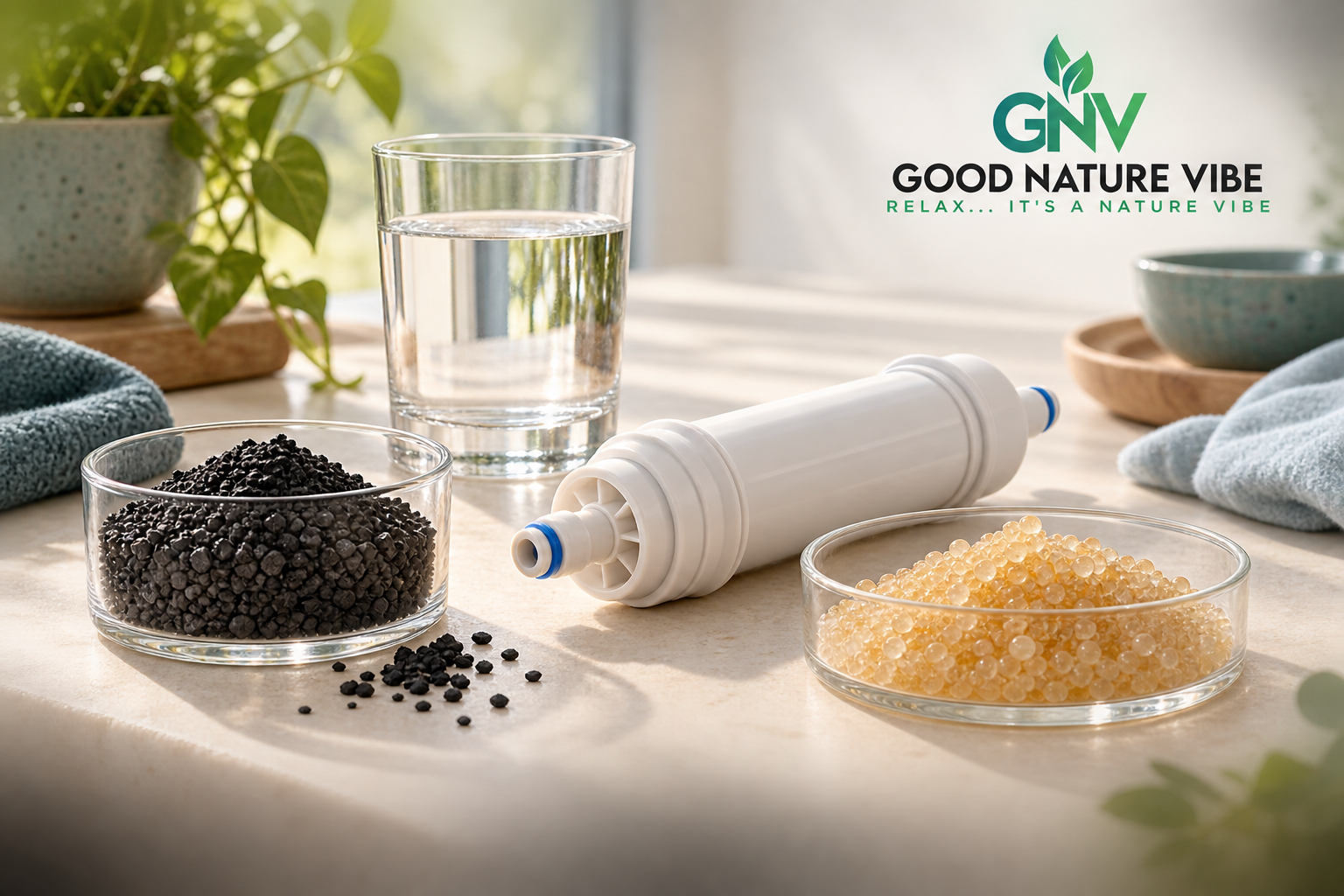
Activated carbon has a very large porous surface area. Substances can adhere to that surface; this process is called adsorption. In professional drinking water treatment, activated carbon has long been used. Many household filters also contain activated carbon, for example in a filter jug, tap filter or under-sink system.
Activated carbon can reduce certain PFAS, but performance varies. The amount and quality of the carbon, the contact time, the flow and the water quality all play a role. A thin filter cartridge in a jug is not necessarily comparable to a larger system in which water has longer contact with the material.
In addition, activated carbon becomes saturated over time. If the filter is used for too long, its effectiveness can decrease sharply. Therefore replace the cartridge according to the manufacturer’s instructions and do not rely on taste or smell alone: you cannot see, smell or taste PFAS.
Reverse osmosis
In reverse osmosis, often abbreviated as RO, water is forced under pressure through a very fine membrane. The membrane can hold back many dissolved substances. Under the right conditions, an RO system can strongly reduce various PFAS.
This technique does require maintenance, usually produces waste water and can also remove minerals from the water. Pre-filters and membranes must be replaced on time. Therefore look at demonstrable PFAS performance, installation requirements and total costs.
Ion exchange
Ion exchangers use resin beads to which certain charged substances can bind. Specific anion-exchange resins can capture PFAS from water. The technique is applied in professional treatment processes and is also available in some household systems.
Here too, the type of resin and the conditions are important. The material has a limited capacity and other substances in the water can affect performance. Therefore, do not only ask which material is in a filter, but also which independent test results are available for the complete product.
What can an ordinary filter jug do?
Many filter jugs are mainly intended to improve the taste and smell of water or to reduce limescale. Activated carbon in a cartridge does not in itself prove any PFAS performance. Check whether the manufacturer can show a specific claim and independent certification for PFAS, PFOA, PFOS or a defined mixture. Use the jug exactly according to the manual and replace the cartridge on time.
What does a PFAS water filter not remove automatically?
A filter that shows good results for one or a few PFAS does not necessarily remove all substances from this broad group. A PFAS claim also says nothing about bacteria, viruses, heavy metals, pesticides, microplastics or other contaminants, unless the product has been tested separately for those. For more background on another form of environmental pollution, also read about microplastics in water, food and air.
Boiling is not a reliable way to remove PFAS from drinking water. PFAS do not simply evaporate the way water does. When water evaporates, non-volatile substances can actually become relatively more concentrated in the remaining water. Therefore use boiling only for purposes for which it is advised, not as a PFAS treatment.
A household filter usually does not destroy PFAS, but captures substances in a cartridge, membrane or resin. Filtration at the tap moreover does not reduce any PFAS in rivers, soil or groundwater. For that, a source-based approach remains essential.
Why do filter results differ?
The actual performance of a PFAS water filter is determined by several factors:
-
The type of PFAS: long and short chains behave differently.
-
The filter material: type, quantity, pore structure and quality all count.
-
The contact time: water that flows through a medium too quickly may get less time to bind.
-
The water chemistry: acidity, minerals, organic matter and other substances can have an influence.
-
The initial concentration: test results apply to the conditions in which the product was examined.
-
The capacity: a new filter performs differently from a cartridge that is almost saturated.
-
The maintenance: incorrect installation, leakage past the filter or late replacement lowers reliability.
So only compare percentages when the test conditions and usage capacity are clear.
How do you assess claims about a PFAS water filter?
Start with the exact claim. ‘Tested’ does not always mean independently certified, and ‘up to 99%’ may apply only to specific laboratory conditions. Check which substances were measured and whether the filter was also tested at the end of its stated service life.
In the United States, NSF/ANSI 53 and NSF/ANSI 58, among others, are used for household water treatment. NSF/ANSI 53 is relevant for certain filters that reduce health-related contaminants; NSF/ANSI 58 relates to reverse-osmosis systems. A standard number on the packaging alone is not enough. Check in the certification database whether the exact model has a specific reduction claim for PFAS, PFOA or PFOS. Manufacturers themselves choose which substances they apply for certification for.
Also pay attention to these questions:
-
Can the exact model be found in a public certification database?
-
For which PFAS does the claim apply exactly?
-
Up to how many litres or months does the claimed performance remain valid?
-
Which flow rate and water pressure are required?
-
What do replacement filters cost and are they readily available?
-
Does the system clearly indicate when replacement is needed?
-
Are there test data for the complete system instead of only the separate filter material?
If specific substances, test standards and capacity data are missing, treat high removal percentages with caution.
Maintenance and timely replacement
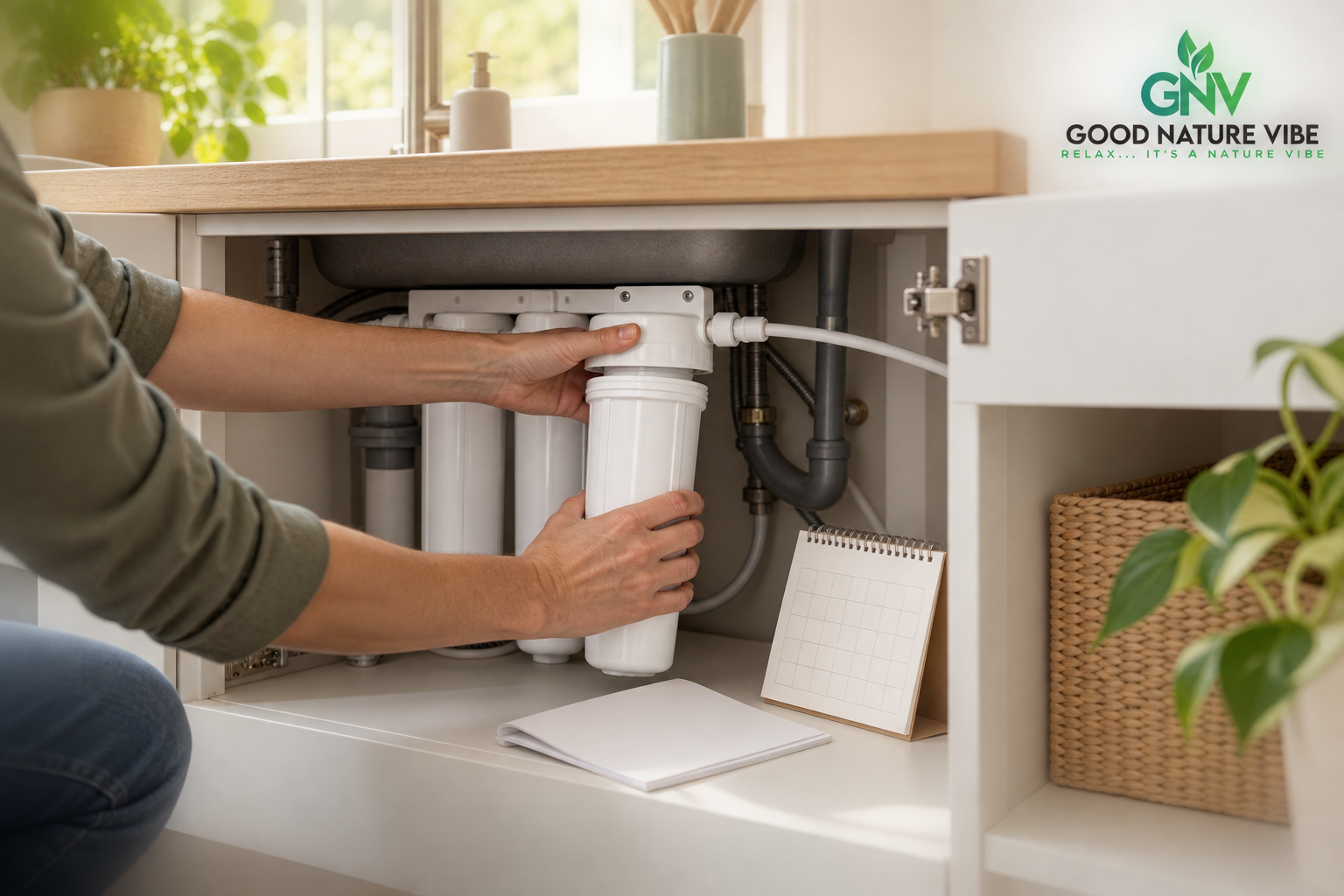
Note the installation date and follow the replacement frequency based on both time and processed volume. Flush a new cartridge according to the manual, use suitable parts and keep reservoirs and taps clean. Anyone who wants to check the effectiveness can have water analysed before and after filtration by a suitable laboratory. A single measurement does remain a snapshot.
Is a water filter necessary in the Netherlands?
An additional PFAS water filter is not a general government recommendation. The Dutch government indicates that the small amounts of PFAS in Dutch drinking water are no reason to stop drinking tap water. In the case of a private source or a local incident, follow the competent authorities. Anyone who still wants an extra reduction step preferably chooses on the basis of local information and verifiable performance, not on the basis of ‘detox’ promises. Our article on PFAS in drinking water gives more explanation about Dutch tap water, measurement results and the context of guideline values.
What do Dutch authorities say about PFAS in drinking water?
According to the RIVM, about sixty percent of Dutch drinking water comes from groundwater. Drinking water made from groundwater contains, on average, less PFAS than drinking water from surface water. According to an RIVM calculation from 2023, people in the Netherlands take in on average about three times as much PFAS through food as through drinking water.
Drinking water companies work on monitoring, purification and source-based measures. In the water sector, activated carbon is used to adsorb PFAS, but the performance of professional installations cannot be translated directly to a household filter jug. In the long term, less emission and less use of PFAS remain most important.
Frequently asked questions about PFAS and water filters
Does a carbon filter remove all PFAS?
No. Activated carbon can reduce various PFAS, but the result differs per substance and filter system. The amount of carbon, contact time, water quality and saturation are especially important. Choose a product with a specific, independently verified reduction claim.
Can I boil PFAS out of water?
No, boiling does not count as reliable PFAS removal. Use a treatment that has been specifically tested for PFAS reduction when you want an extra reduction step.
How often should I replace a PFAS filter?
That differs per model and use. Follow the stated maximum time and capacity and choose the limit that is reached first. If in doubt, you can ask the manufacturer for underlying test data.
Does a PFAS filter also help against microplastics?
That depends on the system and the particle size. A PFAS certification does not automatically prove performance for microplastics. For broader background, also read our article on microplastics in water, food and air.
Good Nature Vibe: a level-headed approach to environmental influences
At Good Nature Vibe, we separate practical choices from big promises. A water filter can offer an extra reduction step, but no product makes exposure to PFAS fully controllable. Look at reliable sources, check product specifications and do not lose sight of the source-based approach. Also read more about toxins and environmental influences.
Conclusion: a water filter can reduce PFAS, but evidence remains necessary
Activated carbon, reverse osmosis and ion exchange can lower the concentration of certain PFAS in drinking water. That does not mean every device removes all PFAS. The specific model, the tested substances, the usage capacity, the water quality and the maintenance together determine what you may expect in practice.
Therefore always check the exact reduction claim and independent certification of the product. Replace filters on time and be cautious with absolute statements such as ‘100% PFAS-free’. For Dutch households, tap water remains drinkable according to the government; an additional filter is mainly a personal, well-informed choice. The most sustainable solution remains preventing PFAS from ending up in our living environment and water sources.


